Wie die Wasserratte schon 1908 zum Maulwurf sagte: "Glaub mir, mein junger Freund, es gibt nichts, absolut gar nichts auf der ganzen Welt, das auch nur halb so viel wert wäre, wie einfach mit Booten herumzubummeln … Ob du dich davonmachst oder ob du es bleiben lässt; ob du dein Ziel erreichst oder ob du ganz woanders ankommst oder niemals irgendwo, beschäftigt bist du immer und etwas Besonderes tust du nie."


Aus "Der Wind in den Weiden", von Kenneth Grahame.


As the Water Rat said to the Mole already in 1908, "Believe me, my young friend, there is nothing – absolutely nothing – half so much worth doing as simply messing about in boats …Whether you get away, or whether you don't; whether you arrive at your destination or whether you reach somewhere else, or whether you never get anywhere at all, you're always busy, and you never do anything in particular."


From "The Wind in the Willows," by Kenneth Grahame.


Donnerstag, 7. Juni 2018

Instapix

Damals, auf der Seine ... gesehen von Henry Bacon, 1839 bis 1912.

Along the Seine, by Henry Bacon (1839-1912). Sent by Long Ponders Anne and Marc to remind us of how it used to be done. Thanks!
Damals, auf der Loing ... als man seinen Frachter noch selbst ziehen musste.

A couple pulling a barge in Saint-Mammès. Life was hard on the Loing.
Keiner, aber wirklich keiner, klaut dieses Dingi!

Nobody's stealing this dinghy. Nobody.


Dieser wunderschöne Garten mit Papagei in Moret-sur-Loing lässt uns sogleich an Lisa und Oswald denken!

Parrots in the garden? Did Lisa and Oswald move to Moret?
Was man für einen Sonntagnachmittag an der Loing so alles braucht ... Dieser Angler ist von seiner Ausrüstung eindeutig überfordert.

This guy had so much fishing gear, his carrier was doomed to fall over. A slapstick moment in Moret.
Über, auf, unter und im Wasser kreucht und fleucht allerlei Getier.

Animal kingdom, above and below.


Eliot, Findelhund aus Spanien, geniesst die Aufmerksamkeit.

In Samois, Aila shows how to tame wild dogs like Eliot.
Schon wieder haben wir eine verwaiste Baby-Giraffe auf freier Wildbahn gesichtet!

We keep running into orphaned giraffes. 
Dieser Kleine ist so scheu, dass er nur unter viel gutem Zureden dazu gebracht werden kann, an uns vorbei zu radeln.

This small man was so shy he almost couldn't bring himself to pass us in Charterettes.
Roy hat wieder einmal zwei Autos gefunden, die sein Männerherz höher schlagen lassen. Dieses Schmuckstück ist eine ihm unbekannte Marke ...

I didn't recognize the mark but it looks like fun. Probably a kit, and clearly a go-er.
... während ihn dieser Chevrolet Pickup wohl an seine Jugend erinnert.

A Chevy pickup in France is cool enough but this one bore a Corsican license plate. Brrrr.
Französische Heckenkunst.

France, hedged. City Hall in Moret.
FaceTime.


Dieses Turmgesicht in in Saint Mammès blickt seit gut 900 Jahren über die Seine.

A nine hundred year old church face in Saint Mammès.

Mittwoch, 6. Juni 2018

Canal du Loing 1

Saint Mammès – Moret-sur-Loing; 2 km, 0 locks, 15 engine minutes.
Wir sind am Ende unserer Fahrt auf der Seine angelangt und bei Saint Mammès in den Canal du Loing abgebogen.

Time to leave the Seine and head into Burgundy. Glug-glug.
Da geht es beschaulicher zu als auf der mächtigen Seine. Um die Ufer nicht zu beschädigen und die Hauboote nicht zum Schwingen zu bringen, darf man hier maximal 6 km/h fahren.

The Canal du Loing is much smaller than the mighty Seine and it has a much lower speed limit --- six whole kilometers per hour. But who's hurrying, especially when it's so pretty?

Plan B im Port d'Escale von Moret.

First stop is Moret-sur-Loing, a town so picturesque you need to pinch yourself. An intact Medieval core, four city gates still standing, an ancient water-driven mill. You get the picture.
Neira geniesst ihr Bauchbad direkt vor der Haustür.

Neira's favorite stop: lots of grass and perfect bathing right outside our door. Woof!
Der Fussweg nach Downtown Moret entlang der Loing ist höchst pläsierlich.

The path into town. Impressionist Alfred Sisley painted this view many times.
Das Städtchen Moret selbst hat so viel mittelalterlichen Charme, ...

There's a lot to see here...
... dass man kaum aus dem fotografieren heraus kommt.

... speaking of old ruins.


Detail der Fassade des Hôtel Chabouillé, das 1527 für Nicolas Chabouillé errichtet wurde, einen königlichen Steuereinnehmer unter François I. Die Steuern müssen damals reichlich geflossen sein ...

The taxman's house in the 16th century.


Robert Louis Stevenson, Verfasser unter anderem der Schatzinsel, liess in der Bootswerft von Moret ein Hausboot bauen lassen, das er allerdings letztlich wegen Geldmangel nicht beziehen konnte.

Local trivia: Robert Louis Stevenson commissioned a houseboat here but he must have left his money on a Treasure Island because in the end he couldn't pay for it.

Dienstag, 5. Juni 2018

@ Fontainebleau

Nachdem wir tagelang am Rande des riesigen Fôret de Fontainebleau entlang gefahren sind, beschliesst  Roy, auch das Château selbst zu besuchen. Weil Hunde aus unerfindlichen Gründen im ehemaligen königlichen Jagdschlösschen nicht erwünscht sind, bleiben wir zwei Girls zuhause.
Nachfolgend Roys Eindrücke auf Englisch. Wer auf Deutsch wissen möchte, was er zu sagen hat, kann seinen Text kopieren, auf diesen Link klicken und den Text dort in die Box platzieren.

Having meandered on the Seine through the vast Forest of Fontainebleau, I decided to visit the famed palace itself. Inexplicably, dogs are unwelcome in this former royal hunting estate, so Neira and her faithful attendant, Aila, could not make the trip. Anyhoo, it's another mind-boggling pile of stone dedicated to the occasional residence of an exalted ruler. 
Occupied since the Middle Ages, and extensively renovated by Napoleon at the start of the 19th century, most of the time it was less visited than Mar-a-Lago is today. No golf, I guess. Touring some of the 1300 rooms with the aid of an excellent audio guide, one cannot help but be struck by the fact that the French decapitated their "elites," the aristos, in the Revolution of 1789 only to install Bonaparte as Emperor just a few years later. One of history's great enigmas (or at least one of the larger gaps in my meager historical knowledge base). 
I liked this map showing how Napoleon held sway over much of Europe after marrying into the those alliance-making Hapsburgs (who generally spent more time worrying about the new uniforms of their equerries than actually ruling). 
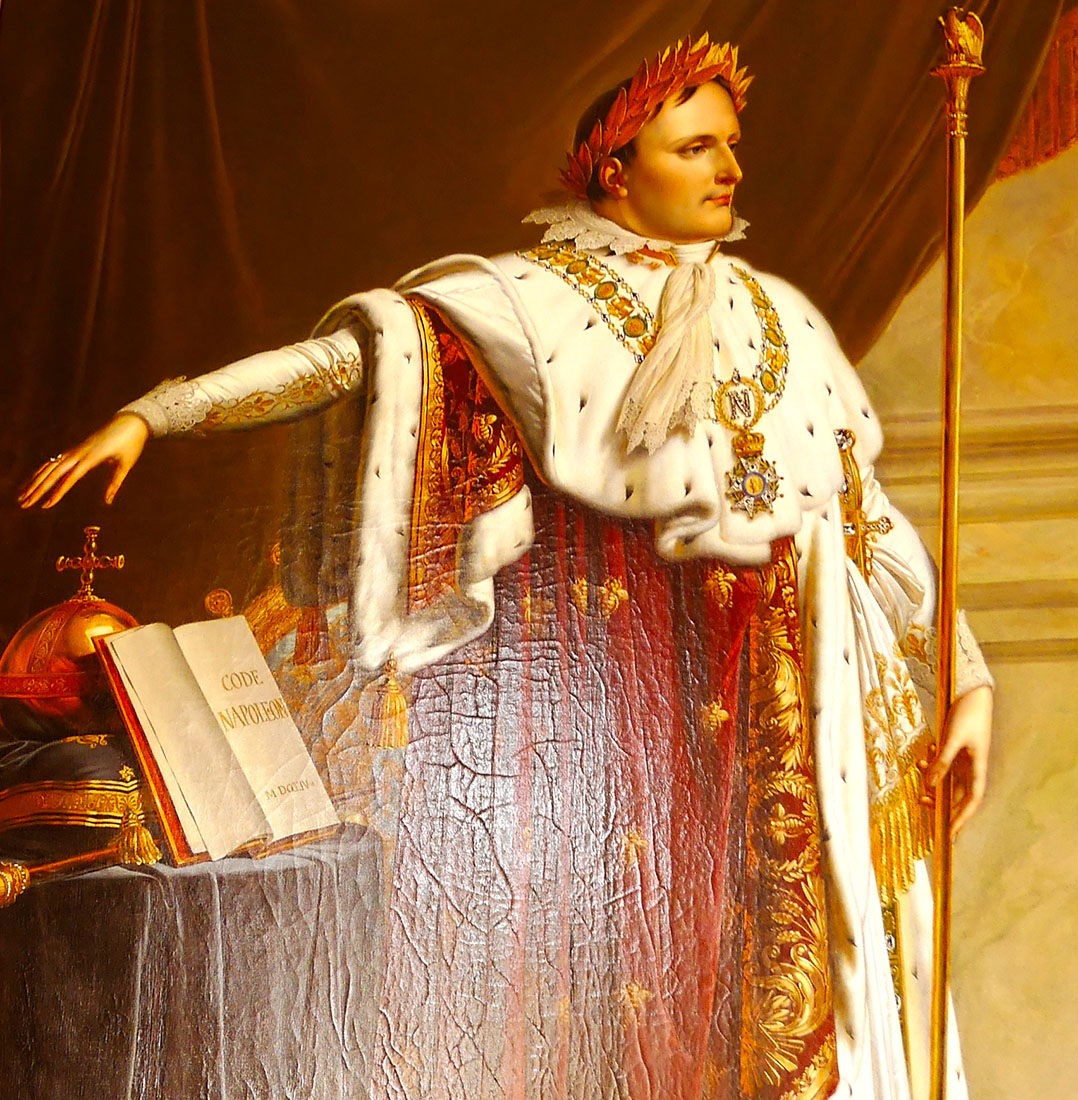
Bonaparte in his coronation robes. God's gift to mankind, obviously.
Not sure who he is but I am sure I wanted to slap him.
The personalized union of Austria and France, a vision of European harmony still out of reach...

I enjoyed the Renaissance wing, decorated in the 16th century and "unimproved" by Napoleon.
Francois the First, 1494-1547, looking good!

I found it interesting that a lot of the decoration was overseen by Florentines. It seems the Italians had what the client wanted, a kind of gilded overkill with a bit of the erotic on the side. Of course, Henry II was married to Catherine de' Medici, so the Italian connection is clear.


On the whole it was very much worth the visit even if it's now largely a monument to Napoleon. (His heirs donated a lot of material to France in the 1980s and it had go somewhere....) Peter the Great visited Fontainebleau in 1717 and evidently found it lacking. Versailles and another royal palace, Chateau Marly, were more to his taste when he built Peterhof outside St. Petersburg.  

Samstag, 2. Juni 2018

Seine Amont 5

Valvins – Saint Mammès; 9 km, 1 lock, 1 engine hour.
Unsere letzte Etappe auf der Seine führt von Valvins nach Saint Mammès.

This stretch takes us from Valvins to Saint-Mammès on the Seine.
Etwa auf halber Strecke müssen wir durch die Écluse Champagne, wo uns das erste Mal, seit wir in Frankreich sind, eine Schleusenwärterin beim Festmachen behilflich ist. Hier sieht man sie oben auf der Mauer, wo sie darauf wartet, dass ihr die Leute im Boot vor uns das Seil zuwerfen.

In the invitingly named Champagne Lock we tossed our ropes up to the keeper and she placed them around the bollards, a courtesy we haven't enjoyed in quite a while.
Wenn man so entspannt durch eine Schleuse kommt, kann man schon eine gute Figur machen.

Aila looking like la Seine herself....

Dann kommen wir nach Saint Mammès, wo es einen Port de Plaisance gibt. Wir hatten vor ein paar Tagen bereits gerüchteweise gehört, dass dieser Hafen zur Zeit nicht benützbar ist: beim Hochwasser von 2016 sei flussaufwärts ein Wehr gebrochen und der ganze Hafen weggeschwemmt worden. Jetzt, zwei Jahre später, sind die Pontons wieder an Ort und Stelle, und sehen von Weitem auch ganz gut aus. Bei näherem Hinsehen sehen wir aber, dass sie mit einem Seil abgesperrt sind. Ungut, denn eigentlich hatten wir geplant, Plan B hier für eine Woche zu parkieren, um einen Besuch in Zürich zu machen.

Our destination was Saint Mammès, the second-busiest barge port on the Seine. We had heard that the weir had broken upstream from here in 2016 and the resultant surge of water had swept away the pleasure boat moorings. But that was back in 2016. We'd also seen a sign in our Paris marina that the little harbor around the corner from Saint Mammès, Moret sur Loing, was back in normal service so no problem in Saint Mammès, right?
Später finden wir weitere Hinweise auf den Wehrbruch von 2016. Damals stieg das Wasser innerhalb kürzester Zeit um sechs Meter. Viele Boote wurden von den Fluten an Land geworfen, und manche liegen da noch immer.

En route, we saw some effects of the high water of 2016, namely a few boats sitting remarkably far from the shore. Hmmm.

An dieser Wasserstandsanzeige kann man sehen, dass das Hochwasser von 2016 eines der höchsten jemals gemessenen war.

2016's high water was one of the biggies.
Zum Glück ist bei unserer Ankunft in Saint Mammès Hafenmeisterin Lauretta zur Stelle. Sie erlaubt uns, am Steg für die grossen Hotelboote festzumachen, was allerdings nicht ganz einfach ist. Es gibt nur einen Ring am Anfang des Stegs und eine Klampe in der Mitte. Weil am Ende des Stegs bereits ein grosses Boot liegt, müssen wir uns in eine kleine Lücke zwängen, wo ein Armierungseisen von der Passerelle drohend über unserem Bug hängt. Zudem ist der Wellengang von den vorbeifahrenden Frachtern beträchtlich. Um nicht in das Eisenteil zu donnern bzw. in das hinter uns liegende Schiff, müssen wir genau an Ort uns Stelle bleiben, und dennoch den Leinen genügend Spiel geben, damit wir nicht gegen den Steg gedrückt werden.

Well, as so often happens on the water, surprises awaited us in Saint Mammès. We had thought we could leave the boat here for a week in order to jump to Zürich but that wasn't on. The marina's floating fingers were still out of service. The harbor master (mistress?) Lauretta allowed us to tie up to the fixed pier used by the big hotel boats. This, by the way, turned out to be one of the most challenging places we've ever moored: a strong current (3km/h), unfavorably placed projections along the edge of the pier that threatened our hull. Tricky, tricky. But we love tying up and finally managed to fashion a safe tie-up. We still bounced in the wash of the barges but the boat was stable and safe. Ok for a couple of nights while we rethought our plans.

Schliesslich ist es geschafft, und wir können stolz sein. Zum Glück haben wir in den Niederlanden viel über das Legen von Springleinen gelernt.

Our secret tie-up sauce? Spring lines (the great rope attachment technique that we learned in the Netherlands) + big ball fenders! 

Endlich kriegt Neira ihr Bauchbad, eines der letzten in der Seine.

Neira chills out one more time in the Seine.
Blick von der Fussgängerbrücke auf den Canal de Loing. Wir hoffen, in Moret sur Loing einen für unsere Reisepläne geeigneten Hafenplatz zu finden ...

Looking out from the footbridge at the junction over the Loing Canal. We hope to find a place at Moret sur Loing for our travel plans....
Als wir zurück kommen, haben wir einen neuen Nachbarn bekommen, nämlich das Flusskreuzschiff Swiss Ruby, mit dem wir in Rouen den Winter verbracht haben! Eine kleine Welt, die grosse Seine.

And when returned to Plan B we saw we's been joined by none other than the Swiss Ruby, a hotel ship that had overwintered with us in Rouen! Small world, la Seine.